
SDX Schema
 SDX Schema
Entity definitions, structure, and consistency principles for the SDX data model.
Data Structure & Hierarchy
As the glue that helps connect systems storing and sharing sports data and content, SDX provides only the core entities that are universal across both sports structures and industry use-cases.
Each SDX Event record in the Registry contains a connected Venue record, and depending on the Sport Structure Type, potentially includes Team records or People records as participants.
team_1v1— Teams (see ERD example here)player_1v1— Players (see ERD example here)player_field— [none] (see ERD example here)
Sport
A Sport is the top-level classification in SDX. It exists to power catalog discovery and to give broadcast, ad-tech, and media systems a stable, universal reference for what is being played — independent of any single competition or provider.
WORKING DEFINITION
A sport is a distinct competitive activity that exists in an organized, sanctioned form — with a governing or sanctioning body, an ongoing elite competition (championships/circuit), and a commercial or broadcast footprint — contested under standardized rules, where the outcome is determined primarily by the participants' skill (physical, fine-motor, and/or tactical) in a genuine, non-staged contest, and which fans and the industry recognize as a sport.
CRITERIA FOR A SPORT
- Distinct, real activity
- Standardized rules
- Organized competitive structure
- Genuine, skill-determined contest
- Fan and industry recognition
VARIANTS
A variant is its own sport when it is a materially different athletic test — not merely the same test at a different scale, length, level, or cosmetic setting. It is a separate sport when it changes at least one fundamental criterion:
Separate sport if it changes…
- Medium / environment that changes the physical skills (sand, water, off-road, ice)
- Core skills & equipment such that proficiency does not fully transfer and athletes specialize
- Essential objective / rules (not just scale)
Same sport when it only changes…
- Number of players
- Court / field fraction
- Match length
- Venue cosmetics
- Level of play
ADAPTIVE / PARA SPORTS
Adaptive and Para sports are modeled as separate SDX sports, not as variants of an able-bodied counterpart. They have their own governing and sanctioning structures and competitions, and several have no able-bodied equivalent (goalball, boccia). This differs from pure level-based modifiers such as youth vs. college vs. pro, which are not separate sports.
EXAMPLES
- Separate sportsBeach Volleyball vs. Volleyball
Sand changes the physical test and athletes specialize.
- Same sportArena Football vs. American Football
Smaller field is a scale change, not environment. Essential objective and rules skeleton is the same and core proficiencies directly transfer.
- Separate sportsBMX vs. Cycling
Different medium, different equipment, and athletes specialize.
Competition
A Competition is the required structural container for all Events within SDX. Every event must belong to a competition to ensure full discoverability. A standard competition will have its own identity and continuity, its own definitive and non-predetermined outcome, own participant pool, independent governance, and a regular cadence.
FIVE CRITERIA FOR A STANDARD COMPETITION
- 01Own identity & continuity
Has a recognized name, brand, and history that persists across editions. Participants and stakeholders refer to it as a distinct thing.
- 02Own definitive and non-predetermined outcome
Produces its own champion, winner, or conclusive result independent of any other competition and not through a staged or scripted event.
- 03Own participant pool
Has a defined set of eligible participants that is determined by its own rules, not wholly inherited from another competition.
- 04Independent governance
Governed by an identifiable body that sets its rules, format, and calendar.
- 05Regular cadence
Recurs on a predictable schedule (annual, biennial, quadrennial, etc.).
COMPETITION TYPES
EXHIBITION / FRIENDLY COMPETITIONS
When events do not belong to a standard competition, they are assigned to an Exhibition/Friendly competition. These containers may not meet all five criteria but provide the structural home required for event discoverability. They fall into two patterns:
- Recurring — A persistent container for an ongoing stream of events that share a common category but lack formal competition structure. Events are added continuously as they occur (e.g., international friendlies, non-title boxing bouts).
- One-off — An individual container for a single event or irregular occurrence with no established recurrence pattern. If the event begins recurring, it may persist under its own name or be absorbed into a broader recurring container (e.g., charity matches, standalone exhibitions).
CONSISTENCY PRINCIPLES
Four principles govern how ambiguous cases are resolved — specifically, what gets its own Competition versus what lives within an existing one.
- Tour Principle
Same participants + unified ranking system = one competition. Individual tour stops are events, not separate competitions.
Applies to: ATP Tour, PGA Tour, F1 World Championship, BWF World Tour, UCI WorldTour
- Aggregation Principle
Same governing body + same teams + same season = one competition. Preseason, all-star games, and in-season tournaments live within the parent competition, not as separate competitions.
Applies to: NFL (+ Preseason + Pro Bowl), NBA (+ All-Star + Summer League), MLB (+ Spring Training + All-Star)
- Tiered Competition Principle
Qualification tiers feeding the same outcome = phases of one competition.
Applies to: Davis Cup World Groups feeding Davis Cup Finals, Billie Jean King Cup tiers
- Attribute Principle
Subdivisions that describe team characteristics, not competition boundaries = team attribute, not competition split.
Applies to: NCAA Football D1 (FBS/FCS is a team attribute)
COMPETITION RELATIONSHIPS
SDX only encodes relationships where Competition A cannot exist without Competition B. If A's entire reason for existing is defined by B, the relationship is recorded. If both can exist independently, no relationship is needed.
A → qualification_for → BCompetition A exists primarily as a pathway to determine entrants into Competition B. Without B, A has no reason to exist.
Examples: World Cup Qualifying → World Cup, FA Cup Qualifying → FA Cup, Bundesliga Relegation Playoff → Bundesliga
A → super_cup_of → BCompetition A is a super cup whose participants are entirely determined by the outcomes of Competition B. Without B, A's format is undefined.
Examples: Community Shield → super_cup_of → Premier League, UEFA Super Cup → super_cup_of → Champions League
A → development_league_of → BCompetition A is an official development league whose club structure is defined by affiliation with Competition B's franchises. Without B, A's clubs would not exist.
Examples: NBA G-League → NBA, MLS NEXT Pro → MLS, MiLB → MLB, ECHL → NHL
EXAMPLES
- LeagueNFL
A season-long league with its own identity, champion, participant pool, governance (NFL Office), and annual cadence. Preseason, Pro Bowl, and in-season events live as phases within the NFL competition.
- TournamentFIFA World Cup
A quadrennial tournament with its own identity, champion, qualification-based participant pool, FIFA governance, and regular cadence. Each edition is a discrete bracketed event producing a definitive winner.
- TourPGA Tour
A unified series with cumulative ranking. Per the Tour Principle: same participants + unified ranking system = one competition. Individual tour stops (The Masters, The Open) are events, not separate competitions.
Event
An Event is the atomic unit of SDX. It is the smallest discrete contest that produces its own distinct result. Every match, game, bout, race, or session that resolves to a definitive outcome (a winner, final score, classification, etc.) is an Event. The event is the anchor point — teams and persons participate in events, venues host events, and competitions organize events into meaningful structures.
EXAMPLES
- Team SportChiefs vs. Bills — AFC Championship
A single NFL playoff game. One discrete contest, one definitive outcome. This event lives within the NFL competition under the 2024 season — Postseason — Conference Championship phase.
- Individual SportDjokovic vs. Alcaraz — Wimbledon Final
A single tennis match within the Grand Slam competition. The match resolves to a winner and is the atomic unit — the tournament bracket is the phase structure above it.
- ExhibitionUSA vs. Mexico — International Friendly
A standalone match that doesn't belong to a standard competition. This event is housed within the International Friendlies (Exhibition/Friendly) competition for discoverability.
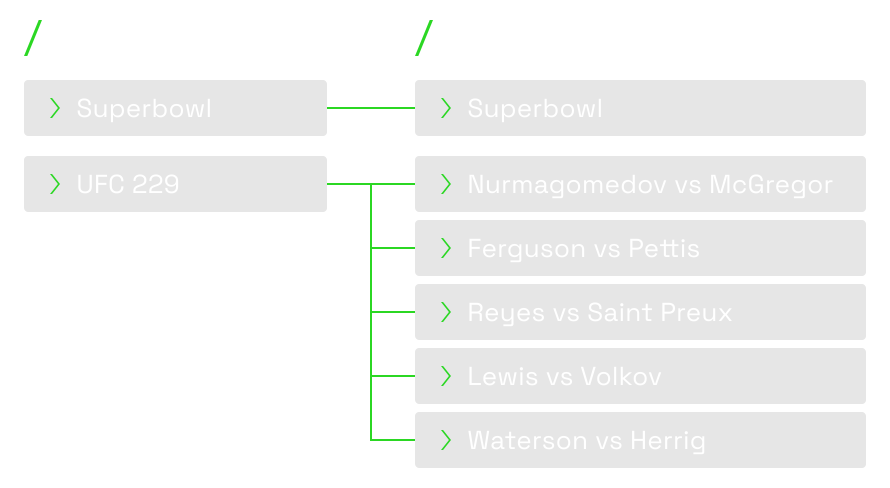
Media Event
Media Events provide abstraction between competitive events and how fans think about and consume sports. For example, UFC 229 is a single Media Event that contains multiple Competitive Events: Nurmagomedov vs McGregor, Tony Ferguson vs Pettis, Reyes vs Saint Preux, Lewis vs Volkov, and Waterson vs Herrig.
Team
A Team is a sporting entity that competes as a collective unit in Events. Teams are the on-field/on-court/on-ice participants in team-based competitions. A Team may be a club (Liverpool FC), a franchise (Los Angeles Lakers), a national team (Team USA men's hockey team), or a constructed roster (Europe Ryder Cup Team).
Some teams are perpetual institutions with continuous rosters while others are assembled for a single competition cycle.
EXAMPLES
- FranchiseDallas Cowboys
A perpetual NFL franchise. The team entity persists year over year with a continuous identity, even as rosters, coaches, and ownership change. Participates in events within the NFL competition.
- National TeamTeam USA Men's Hockey
A national team assembled for specific competition cycles (Olympics, IIHF World Championship). The team entity persists across editions, but the roster is constructed fresh each time.
- Constructed RosterEurope Ryder Cup Team
A team constructed for a single competition cycle. Players are selected specifically for this event — the team entity exists within the Ryder Cup competition context.
Person
A Person is an individual with a role in the sports ecosystem. A Person may be an athlete, agent, coach, executive, broadcaster, official/referee, or any other individual relevant to SDX.
Persons can hold multiple roles simultaneously or over time — former athletes may become coaches, broadcasters, agents, etc. In individual sports, such as golf and tennis, persons are participants within an Event.
EXAMPLES
- Multi-RoleTom Brady
One Person, one SDX ID — spanning multiple roles over time. Player (NFL), broadcaster (Fox Sports), and minority owner (Las Vegas Raiders). SDX tracks the person across all roles without duplication.
- Individual AthleteScottie Scheffler
In individual sports like golf, the Person is a direct participant on Events. Scheffler competes in PGA Tour events — no team intermediary. The Person entity connects directly to the Event.
- CoachPep Guardiola
A Person in a coaching role. Linked to teams (Manchester City) and competitions (Premier League, Champions League) through that role. If he later moves to broadcasting, the same Person entity gains a new role.
Venue
A Venue is a specific physical structure or location where Events take place. It may be a stadium, arena, course, circuit, track, complex, or defined route.
EXAMPLES
- StadiumLincoln Financial Field
A traditional stadium venue. Home of the Philadelphia Eagles (NFL). Events held here are linked to this venue entity — regardless of which competition they belong to.
- CircuitSuzuka Circuit
A motorsport venue. Hosts Formula 1 Japanese Grand Prix events, MotoGP events, and others. The circuit is a single venue entity that connects to events across multiple competitions.
- Defined RouteBoston Marathon Route
A venue doesn't have to be an enclosed structure. The 26.2-mile course from Hopkinton to Copley Square is a defined route — a venue in SDX just like any stadium or arena.

